
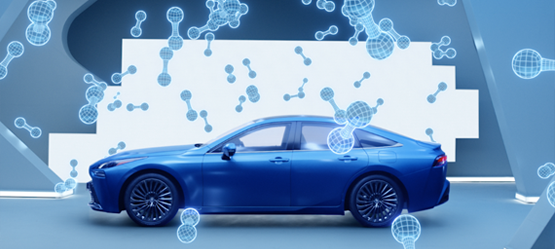
During the last years, research in hydrogen production and its utilisation as a clean source of energy has been increasing exponentially. Nowadays, hydrogen is becoming a strong candidate to surpass fossil fuels as the source of energy in different sectors, being the automotive industry the sector where hydrogen is obtaining more attention.

Electricity Generation Mix 2020 (Belgium)
Most electrical vehicles are powered by the same energy that we use in our daily life. We use electricity to charge the batteries of electrical cars, which will be then converted into mechanical power by an electric motor. The electricity used is obtained by multiple sources, such as nuclear energy, thermal power plants (which use natural gas and coal), and a very small percentage of renewable energies (wind, solar, biogas, hydroelectric power plants, etc).
In order to achieve the goals set for reducing our emissions in the next coming years, hydrogen powered vehicles have been developed as the cleanest alternative in the automotive sector. As hydrogen is possibly the cleanest fuel to be used, it is fundamental to develop the technologies to make hydrogen production and storage more affordable and efficient.

Scheme of an hydrogen fuel cell in a vehicle
In hydrogen powered vehicles, hydrogen enters a fuel cell in which electricity will be generated via the electrochemical reaction to produce water from gaseous hydrogen and oxygen. Here’s how fuel cells work and the reactions that occur:
- Hydrogen atoms (H2) enter at the anode, to produce positively charged protons and electrons. This will be the oxidation reaction:
Anode: H2(g) —> 2H+ + 2 e-
2. The charged protons H+ pass through the membrane to the cathode and the negatively charged electrons are forced through a circuit, entering the cathode and generating electricity
3. Oxygen atoms (O2 from the air) enter at the cathode, where they will be combined with the electrons to generate water and heat. This will be the reduction reaction.
Cathode: 1/2 O2(g) + 2 e- + 2 H+ —> H2O (l) ΔH= -285.8 kJ/mol
The overall reaction is the following:
H2(g) + 1/2 O2(g) —> H2O(l)

Scheme of a fuel cell
One of the challenges linked with this technology, is the fact that hydrogen must be produced by a “green” source if we aim to claim Fuel Cell Electric Vehicles (FCEV from now on) as the cleanest alternative in automotion. For this reason, many research institutions and private companies are dedicating resources to optimise the production of hydrogen, being green and blue hydrogen the cleanest options. Both sources of hydrogen are very different. Research in green hydrogen will take a few years and changes in the political and financial system of the countries and European Union (reduction of taxes for renewable energies for example) in order to become a feasible option. For the moment, blue hydrogen obtains most of the attention since its production via steam reforming of methane, is well studied. The source, gas natural, is easily obtained and stored. We must optimise all steps in steam reforming of methane and in carbon capture in order to make it as “clean” as possible .
No responses yet