

The 20th century marked the history of global industry. The industrial revolution has allowed the whole world to evolve considerably, at high speed, transforming fossil carbon resources (natural gas, oil and coal) into energy but also into reaction products with environmental and climatic impacts which we can see today. The 21st century will mark an important energy transition. Therefore, to preserve future generations and its habitat, humanity must rethink how it produces and consumes energy by considering operating without net emissions of fossil carbon into the atmosphere. The development of new alternatives such as nuclear fusion cannot be considered a realistic alternative in the short term. As a result, sustainable energy production solutions attempt to meet ever greater demand and the major challenge that justifies the success of fossil resources to date energy storage.
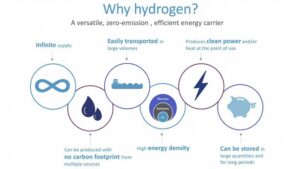
The hydrogen economy is growing rapidly at the international level with enormous challenges both politically and technologically. Different countries with partnerships and organizations are working with cooperation and communication for the advancement of the hydrogen economy through advanced research and development. In addition, hydrogen has a comparatively high energy content compared to other conventional fuels. hydrogen represents the role of energy vector which allows the energy transition to carbon-free energy.
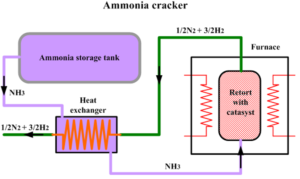
It appears that ammonia is a compound likely to play a key role in the problem of storage and transport of hydrogen. Ammonia is a colorless, irritating odor gas that is lighter than air. Based on the ammonia phase diagram, the boiling point of pure ammonia is 239.72 K (-33.35 ° C), its melting point at normal pressure is 195.5 K (-77.7 ° C) and its auto-ignition temperature is 924 K (651 ° C) under atmospheric conditions. Ammonia has a heat of vaporization of 23.3 kJ / mol at its boiling point. The pure ammonia being liquefiable at a pressure of some 8.6 atm at 20 ° C, it is indeed possible to envisage as a means of storage of hydrogen. The latter product would be on-demand by the reverse of that of the Haber-Bosch process and could be used for applications where hydrogen storage and safety occur without problem.
No responses yet